
Unveiled in 2005 and launched in November 2006, Sony’s PlayStation 3 was powered by the Cell Broadband Engine—a joint $400M architecture co-developed with IBM and Toshiba. Promoted with claims of teraflop floating-point throughput, real-time supercomputing, and complete generational dominance, the hardware promised to trivialize complex modern physics. Yet, when Rockstar Games shipped Grand Theft Auto IV in April 2008, low-level programmers were met not with an effortless supercomputer, but with one of the most hostile memory and execution models in the history of consumer electronics.
While Microsoft’s Xbox 360 provided a comfortable, symmetric multi-core environment executing standard C++ multithreaded code across a flexible, unified 512 MB RAM pool, the PlayStation 3 was a radical engineering anomaly. Bringing Liberty City to life demanded a complete paradigm shift: migrating high-frequency rigid-body physics, procedural character animation via NaturalMotion’s Euphoria engine, and continuous asset streaming into an aggressive, asymmetric architecture.
This article is a systems-level teardown of how Rockstar Games’ RAGE engine conquered the Cell processor: the 1 PPE + 6 SPE distribution pipeline, the brutal logistics of managing 256 KB Local Store limits via asynchronous Direct Memory Access (DMA), and the visual compromises forced by the PS3’s split-memory bottleneck.
1. The Supercomputer Delusion: PS3’s Heterogeneous Reality
The Cell Broadband Engine was fundamentally a vector-processing pipeline designed around asymmetric multiprocessing. At its center sat a single PPE (Power Processing Element)—a dual-threaded, 64-bit PowerPC-based core running at 3.2 GHz. Surrounding the PPE were eight SPEs (Synergistic Processing Elements), small, highly streamlined vector coprocessors operating at the same clock speed, each containing a SPU (Synergistic Processing Unit) and a specialized 256 KB local memory space called the Local Store (LS). One SPE was permanently disabled at the factory to boost silicon yield, and a second was reserved exclusively by Sony’s Hypervisor / GameOS, leaving developers with exactly 6 usable SPEs for general computational workloads.
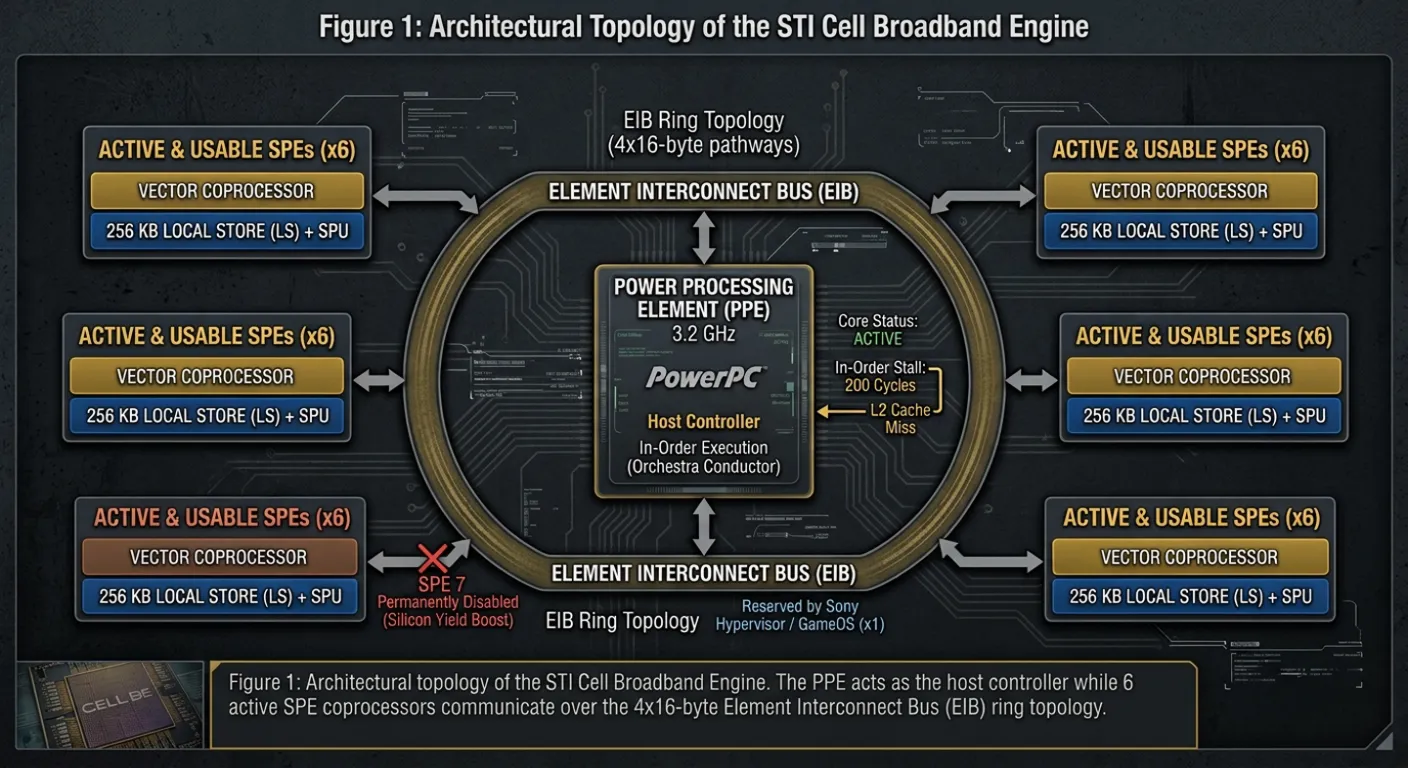
Figure 1: Architectural topology of the STI Cell Broadband Engine. The PPE acts as the host controller while 6 active SPE coprocessors communicate over the 4x16-byte Element Interconnect Bus (EIB) ring topology.
The theoretical computational capabilities of this setup were staggering. A single SPE could execute up to 4 single-precision floating-point operations per cycle using its 128-bit SIMD registers:
Across 6 available SPEs, the raw vector performance reached:
When combined with the PPE’s vector processing unit (Altivec/VMX), the chip touted roughly 200 GFLOPS of theoretical performance. However, this theoretical compute peak was locked behind a severe architectural catch: the PPE core was an in-order execution engine.
In-Order Execution Pitfall: Modern desktop CPUs (and the Xbox 360’s Xenon cores to a degree) rely on out-of-order execution (OoOE) to dynamically reorder instructions around memory stalls and cache misses. The PS3’s PPE had no such luxury. If a thread running on the PPE suffered an L2 cache miss, the pipeline completely stalled for up to 200 clock cycles. Standard C++ code with deep pointer-chasing (typical of C++ object graphs in game engines) ran appallingly slow on the PPE.
Consequently, treat the PPE as nothing more than an orchestra conductor. If a developer attempted to run classic monolithic C++ game loops, AI decision trees, rendering setup, and physics simulation entirely on the PPE, the PS3 ran slower than a mid-tier Pentium 4. To extract performance, game systems had to be radically broken down, vectorized, and offloaded to the autonomous SPE coprocessors.
2. Asymmetric Multithreading: Offloading Euphoria & Driving Physics
The Xbox 360 featured three symmetric PowerPC cores (6 hardware threads) with equal access to a shared L2 cache and unified memory. Although Xenon cores were also in-order execution engines, standard multi-threading paradigms—such as splitting workloads across conventional threads using thread pools or OpenMP—worked naturally thanks to a shared, cache-coherent memory hierarchy.
On the PS3, this model collapsed entirely. The SPEs were not general-purpose cores. They had no hardware L1/L2 data cache backstop for standard pointer load/store operations, no standard branch prediction hardware, and no instruction set compatibility with standard PowerPC/x86 code. A traditional C++ thread could not simply be dispatched to an SPE.
To run Grand Theft Auto IV, Rockstar’s RAGE (Rockstar Advanced Game Engine) team had to re-architect their physics and animation pipelines into a Job-Manager model.
Offloading Euphoria & Rigid-Body Physics to SPEs
GTA IV introduced two revolutionary systems to open-world games:
- Procedural Animation (NaturalMotion Euphoria): Instead of playing back pre-baked death animations, Euphoria synthesized biomechanical motor-control responses in real-time. It simulated central nervous system reflexes, muscle tensions, balance constraints, and skeleton momentum.
- Vehicle Dynamics & Collision Physics: High-frequency raycast suspension modeling, tire friction curves, soft-body deformation, and complex rigid-body collisions for dozens of active vehicles.
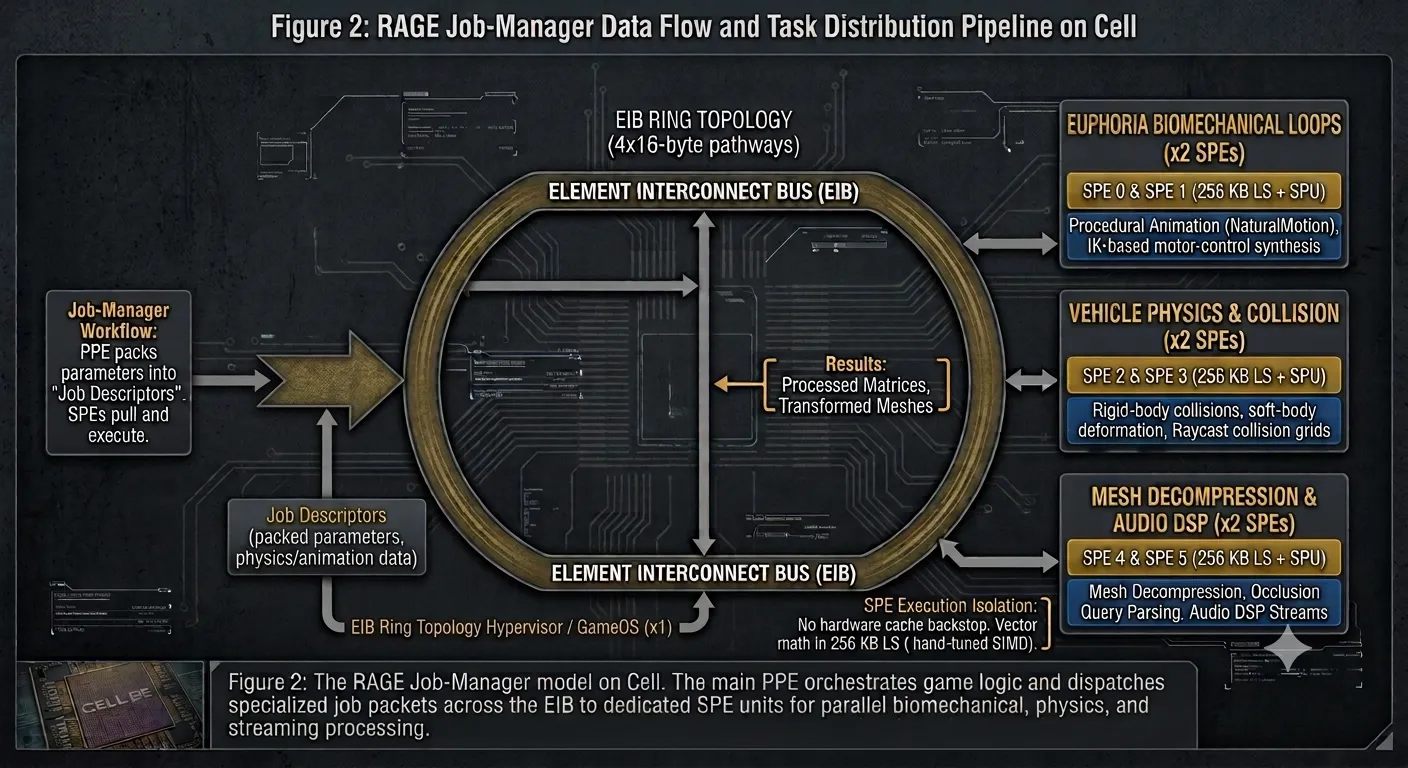
Figure 2: The RAGE Job-Manager model on Cell. The main PPE orchestrates game logic and dispatches specialized job packets across the EIB to dedicated SPE units for parallel biomechanical, physics, and streaming processing.
Because these calculations were mathematically intense, deterministic, and vectorizable, they were prime candidates for the SPEs.
- PPE Responsibility: Managed gameplay logic, mission scripting, high-level AI pathfinding, audio mixing routing, and operating system calls. It packed simulation parameters into lightweight “Job Descriptors”.
- SPE Responsibility: Pulled Job Descriptors, executed raw vector math in isolation, and returned transformed matrices. SPE 0 and SPE 1 ran Euphoria biomechanical loops; SPE 2 and SPE 3 processed vehicle physics and raycast collision grids; SPE 4 and SPE 5 handled mesh decompression, occlusion query parsing, and audio DSP streams.
Euphoria on SPEs: Simulating human biomechanics in real-time required solving complex inverse kinematics (IK) and multi-body rigid dynamics every frame (33.3 ms). An SPE could compute an entire character’s muscular reaction in microseconds using hand-tuned SIMD vector registers, freeing the PPE from hundreds of thousands of matrix transformations.
3. The 256 KB Local Store Hell and Manual DMA Plumbing
The single most brutal bottleneck on the Cell processor was memory isolation. An SPE could not read directly from the PS3’s main 256 MB Main RAM (XDR) or 256 MB Video RAM (GDDR3).
Instead, each SPE could only execute code and read/write data that physically resided inside its own 256 KB Local Store. This 256 KB memory space was shared between the executable code (microcode binary), the stack, and the data buffers.
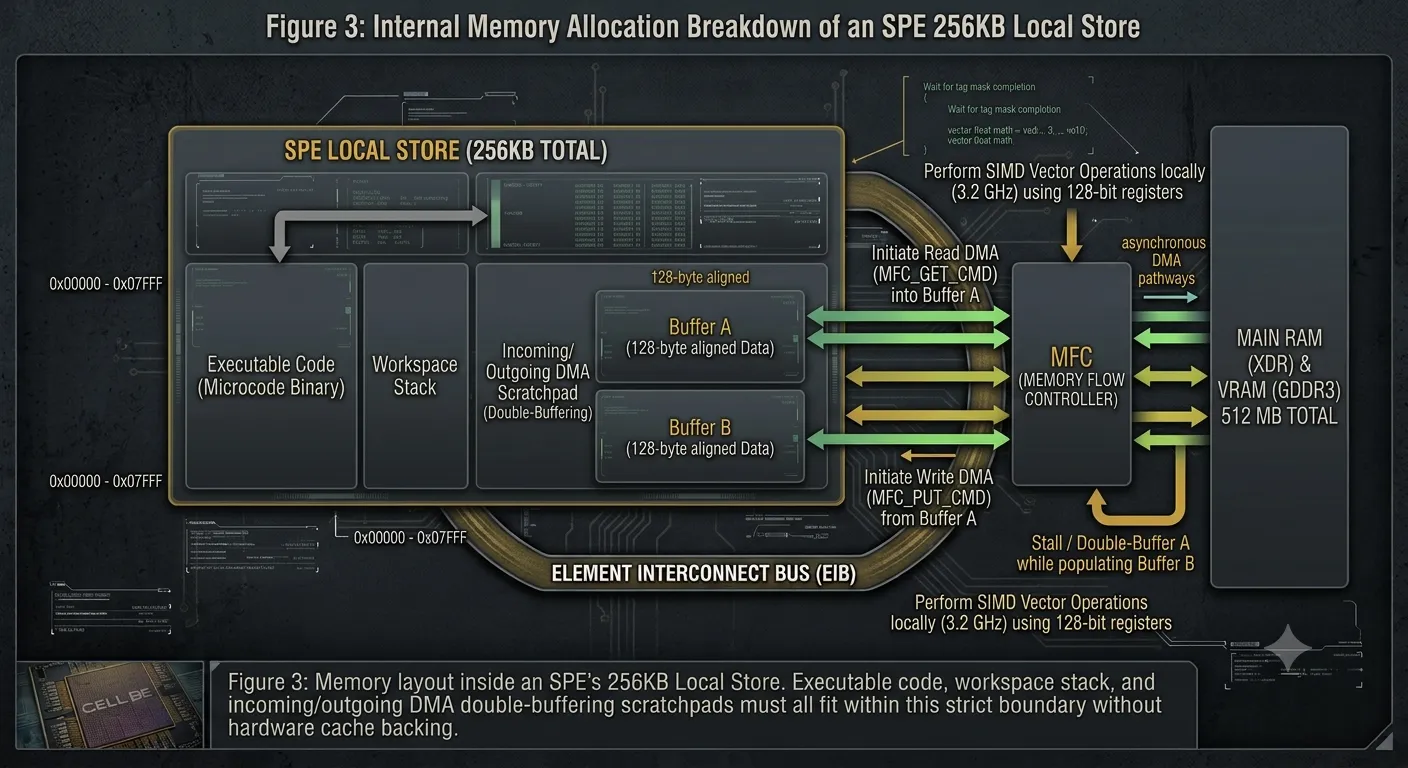
Figure 3: Memory layout inside an SPE’s 256KB Local Store. Executable code, workspace stack, and incoming/outgoing DMA double-buffering scratchpads must all fit within this strict boundary without hardware cache backing.
There was no hardware-managed L1 or L2 data cache on the SPE to silently pull missing memory blocks from main RAM. If an SPE program requested a memory address outside its 256 KB Local Store, the hardware did not auto-fetch it—it simply could not address it.
The Mechanics of Asynchronous DMA Transfers
To process a mesh, collision tree, or ragdoll instance on an SPE, developers had to write manual Direct Memory Access (DMA) instructions issued to the MFC (Memory Flow Controller) interface attached to each SPE.
The data pipeline operated on a strict asynchronous pattern:
- Initiate Read DMA: Command the MFC to fetch a block of data from main XDR RAM over the Element Interconnect Bus (EIB) into Local Store Buffer A.
- Stall or Double Buffer: The SPE waits for a tag group completion mask signal (or computes on Local Store Buffer B while A populates).
- Execute Vector Operations: Process the data locally at full processor speed (3.2 GHz) using 128-bit SIMD registers.
- Initiate Write DMA: Issue an MFC request to write the computed results back out to main XDR RAM or VRAM.
To prevent the SPE from idling during DMA transfers, Rockstar utilized double-buffering. While SPE processing was executing on Buffer A, the MFC was concurrently streaming incoming DMA data into Buffer B over the Element Interconnect Bus (EIB). This kept the execution units saturated, but required splitting the already tiny 256 KB space into even smaller sub-scratchpads.
4. The Memory Split Bottleneck: PS3 vs. Xbox 360
While processor pipelines presented software architecture challenges, physical memory limits forced hard graphic and rendering compromises on the PS3 release of GTA IV.
| Hardware Spec | Microsoft Xbox 360 | Sony PlayStation 3 |
|---|---|---|
| Total System RAM | 512 MB Unified GDDR3 | 512 MB Split Partitioned |
| System RAM Allocation | Shared dynamically (e.g. 300 MB VRAM / 212 MB Sys) | Fixed: 256 MB XDR Main + 256 MB GDDR3 VRAM |
| Main Memory Bandwidth | 22.4 GB/s to main system | 25.6 GB/s (XDR Main RAM) |
| GPU Memory Bandwidth | 22.4 GB/s (Unified) | 20.8 GB/s (GDDR3 VRAM) |
| eDRAM / Daughter Die | 10 MB Daughter Die (Fast MSAA fillrate) | None |
| Bus Topology | Flexible Unified Interconnect | Rigid Split-Bus Architecture |
The Split-RAM Trap
The Xbox 360 allowed game developers to allocate its 512 MB unified pool flexibly. If a game like GTA IV required more geometry and system state memory for streaming, developers could allocate 320 MB to system RAM and 192 MB to textures and render targets.
The PS3 enforced a rigid, hard-partitioned wall:
- 256 MB XDR System RAM (Ultra-fast, low-latency RAM reserved for CPU, SPEs, and game state).
- 256 MB GDDR3 VRAM (Dedicated strictly to RSX GPU render targets and texture maps).
If the RSX GPU ran out of VRAM in a dense scene, it could technically access main XDR RAM over the FlexIO bus, but reading across this bridge incurred a massive bandwidth penalty. Furthermore, if game logic running on the PPE needed more than 256 MB of main RAM, it could not borrow a single kilobyte from the 256 MB VRAM pool, regardless of how much GPU memory was free.
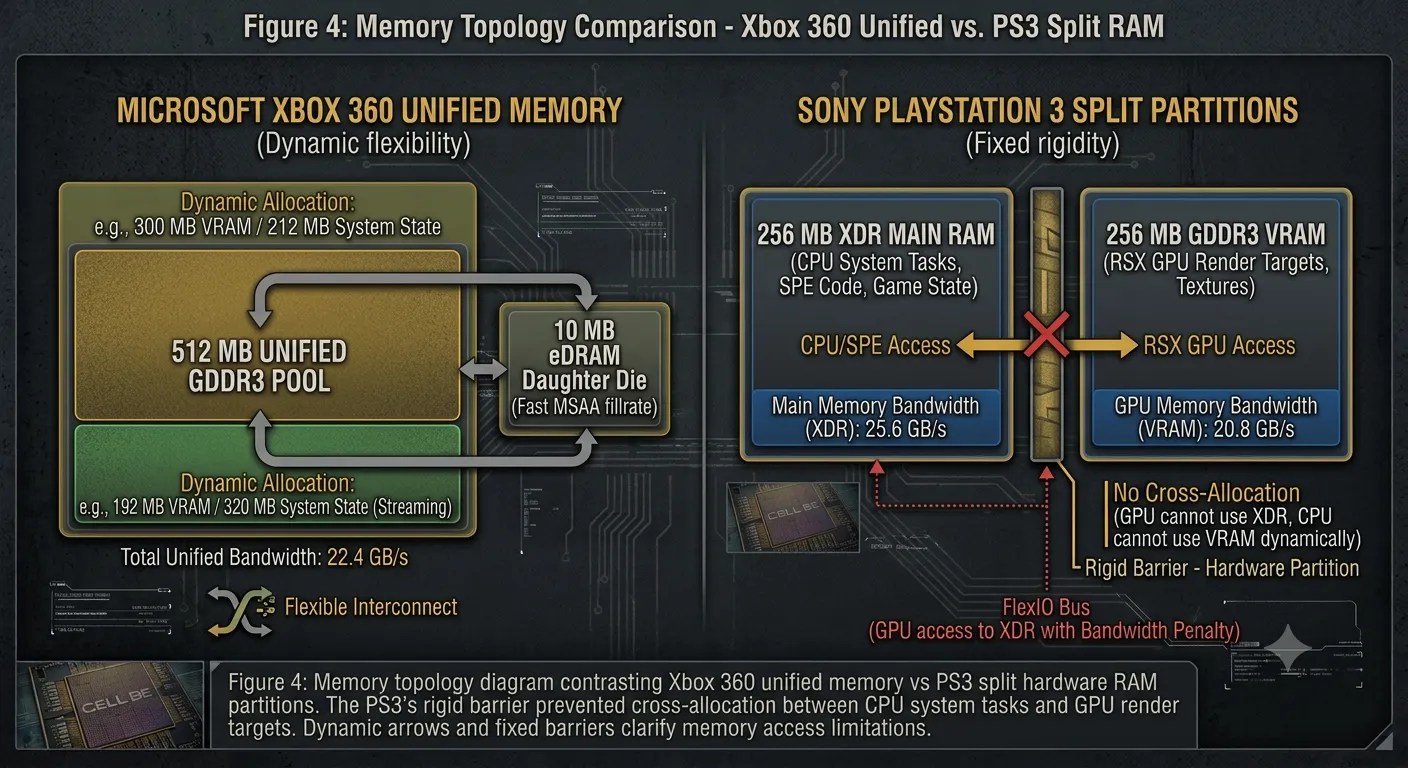
Figure 4: Memory topology diagram contrasting Xbox 360 unified memory vs PS3 split hardware RAM partitions. The PS3’s rigid barrier prevented cross-allocation between CPU system tasks and GPU render targets. Dynamic arrows and fixed barriers clarify memory access limitations.
The 640p Rendering Compromise and Blur Filters
This rigid partition had immediate consequences for GTA IV’s rendering pipeline on PS3:
- Lack of eDRAM for Anti-Aliasing: The Xbox 360 GPU featured a dedicated 10 MB eDRAM module directly on the GPU die, capable of performing 2x or 4x Multi-Sample Anti-Aliasing (MSAA) at virtually zero fill-rate cost. The PS3’s RSX GPU (based on NVIDIA’s G70 architecture) lacked eDRAM entirely. Running native 2x MSAA at 720p consumed precious VRAM and destroyed the frame rate.
- Resolution Downscaling: To maintain a target frame rate of 30 FPS while managing VRAM allocations for framebuffer targets, depth buffers, and dynamic shadow maps, Rockstar was forced to downscale the PS3 frame output:
- Xbox 360 Resolution: Native 1280x720 (720p) with 2x MSAA.
- PS3 Resolution: Native 1152x640 (640p) with no hardware MSAA.
- Software Anti-Aliasing & Post-Process Blur: To mask the severe aliasing artifacts caused by scaling a 640p image to 720p or 1080p displays, Rockstar implemented a heavy post-processing screen-space blur filter on PS3. While this successfully mitigated jagged edges, it gave the PS3 version its characteristic softer, distinctly “fuzzier” visual presentation compared to the Xbox 360.
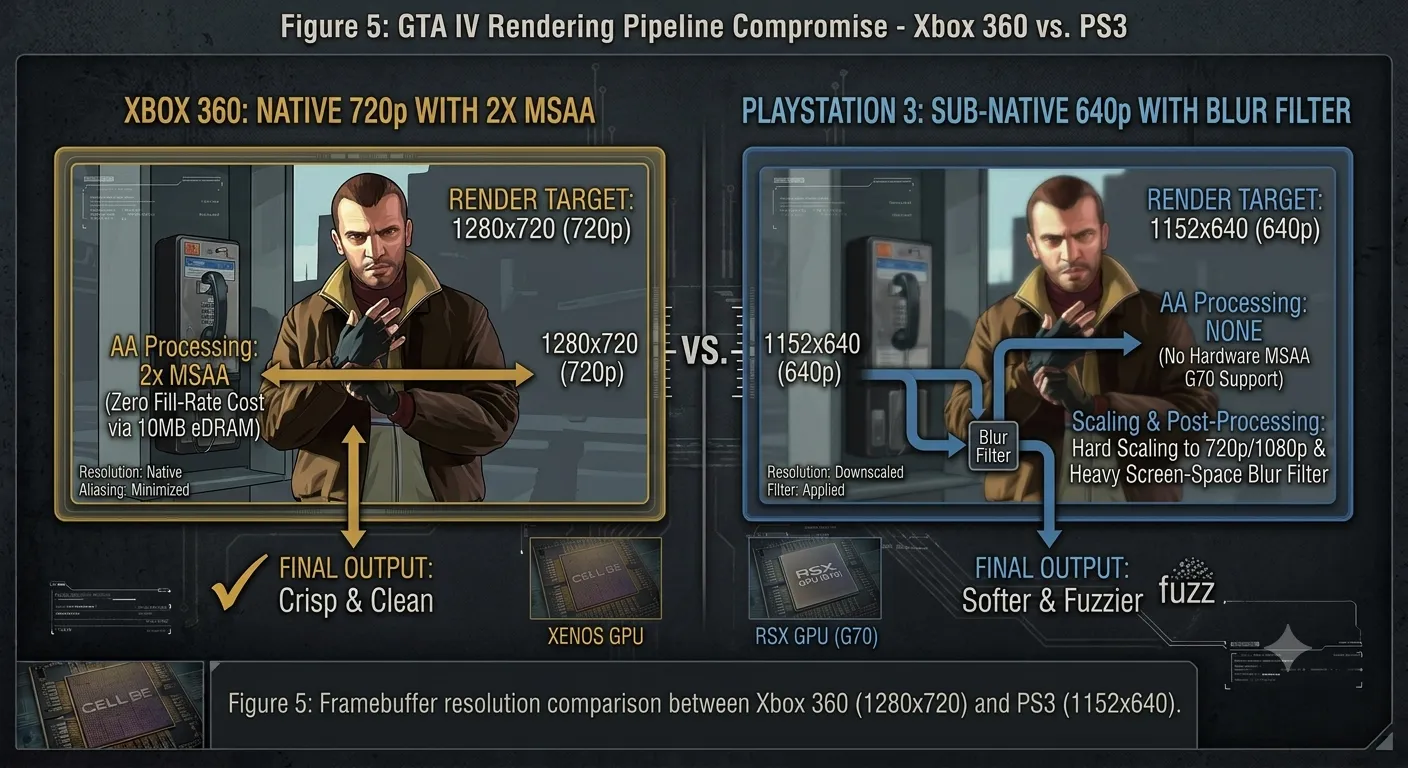
Figure 5: Framebuffer resolution comparison between Xbox 360 (1280x720) and PS3 (1152x640).
5. Conclusion: A Masterclass in Bare-Metal Adaptation
Grand Theft Auto IV on the PlayStation 3 remains one of the most remarkable technical achievements of the Seventh Console Generation. What appeared on the surface to be a slightly lower-resolution port was, under the hood, a complete reimagining of modern game engine execution pipelines.
Rockstar Games took an architecture that rejected modern standard programming conventions and forced it into submission. They abandoned conventional high-level C++ abstraction layers, designed custom DMA-driven microcode pipelines, offloaded complex biomechanical procedural math to six isolated vector coprocessors, and navigated one of the most restrictive memory topologies in modern gaming history.
The Cell Broadband Engine was eventually retired—future console generations unanimously adopted unified memory architectures and symmetric x86-64 multi-core CPUs. Yet, the architectural lessons learned from squeezing Liberty City into 256 KB Local Stores paved the way for modern job-system task schedulers, compute-shader pipelines, and low-level explicit graphics APIs (Vulkan, DirectX 12) used across the industry today.
References & Further Reading
- Gschwind, M. (2006). Chip Multiprocessing with the Cell Broadband Engine. IEEE Micro Journal. Deep technical architectural breakdown of PPE, SPE, and EIB ring bus specifications.
- Riley, M. W., Warnock, J. D., & Wendel, D. F. (2007). Cell Broadband Engine Processor: Design and Implementation. IBM Journal of Research and Development, 51(5), 545–557. Comprehensive technical paper on the circuit design, SoC implementation, and manufacturing constraints of the Cell BE processor.
- Wikipedia. Euphoria (software). Technical background on NaturalMotion’s Dynamic Motion Synthesis middleware, real-time procedural animation, and source code integration with Rockstar’s RAGE engine in Grand Theft Auto IV.
- PS3Dev Wiki Archives. Cell Broadband Engine and RSX Hardware Specifications. Community-preserved low-level hardware documentation, DMA register layouts, and memory maps.
Technical Glossary
| Term | Definition |
|---|---|
| Cell Broadband Engine | The high-performance heterogeneous microprocessor developed by Sony, Toshiba, and IBM (STI) powering the PlayStation 3 console. |
| PPE (Power Processing Element) | The primary general-purpose 64-bit PowerPC dual-threaded core on the Cell processor, clocked at 3.2 GHz. |
| SPE (Synergistic Processing Element) | One of eight specialized, independent vector coprocessor units on the Cell processor optimized for high-throughput single-precision SIMD vector operations. |
| Local Store (LS) | A dedicated, ultra-fast 256 KB SRAM address space local to each SPE, housing both the executable microcode and computational data buffers. |
| DMA (Direct Memory Access) | Hardware-mediated asynchronous memory transfer commands executed via the Memory Flow Controller (MFC) to move memory blocks between main RAM and Local Store. |
| EIB (Element Interconnect Bus) | A high-bandwidth internal circular ring bus connecting the PPE, SPEs, memory controller, and GPU interface at up to 204.8 GB/s. |
| Euphoria Engine | A procedural animation synthesis runtime created by NaturalMotion that calculates biomechanical motor dynamics and physics responses in real time. |
| RSX ‘Reality Synthesizer’ | The PS3’s graphics processing unit co-developed by NVIDIA (based on the NV47/G70 architecture) operating at 550 MHz with 256 MB GDDR3 VRAM. |
| XDR DRAM | Extremely low-latency Rambus DRAM used as the main system memory (256 MB) on the PS3, running on a 64-bit bus delivering 25.6 GB/s. |
| In-Order Execution | A CPU pipeline design where instructions are processed strictly sequentially without hardware-level dynamic reordering, causing severe stalls during memory latency. |