The Brief
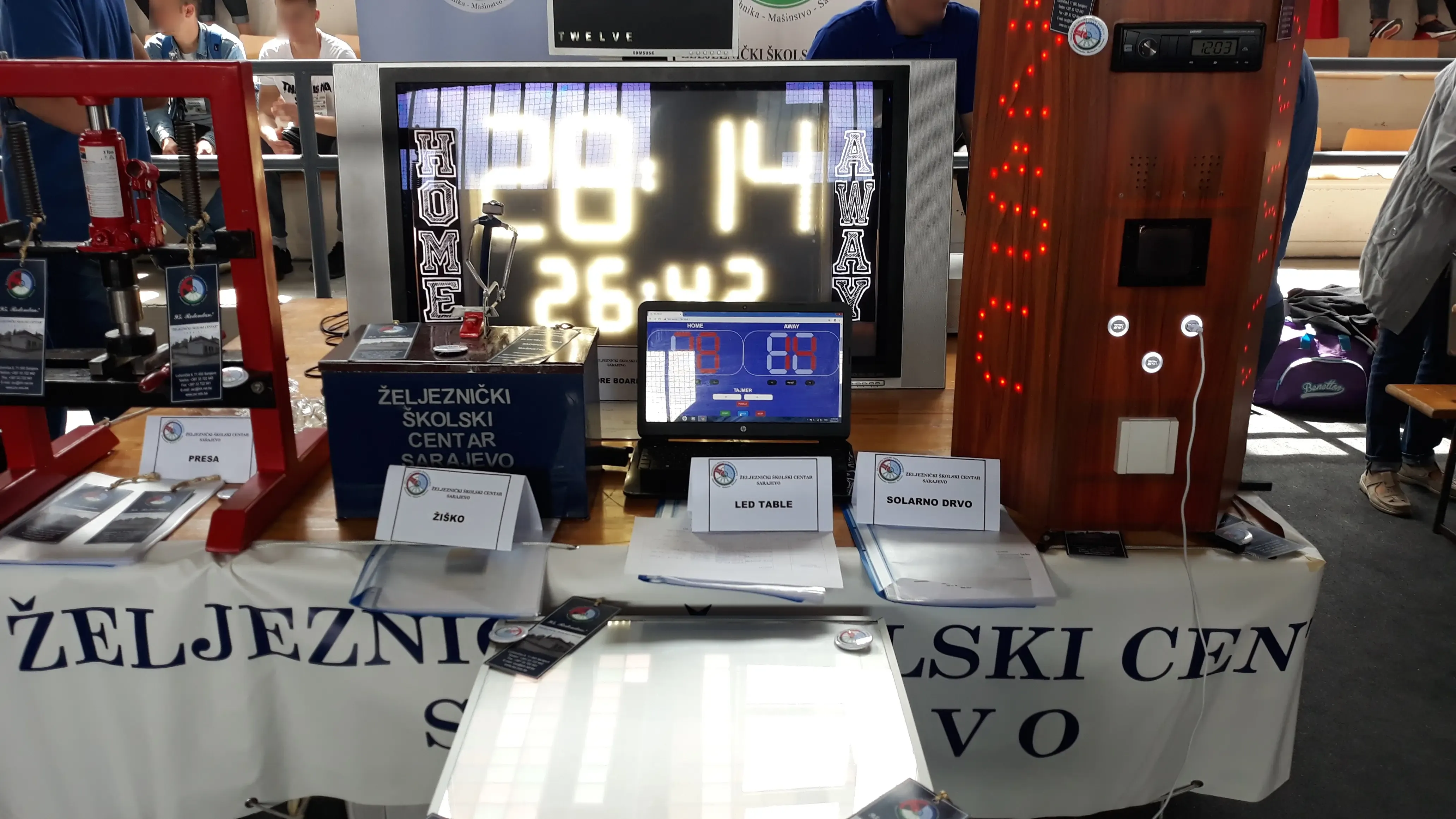
Traditional sports scoreboards rely on expensive, proprietary hardware controllers or wired interfaces that limit mobility and increase installation complexity. Developed as part of a competitive student team under academic mentorship, this project aimed to build a low-cost, high-visibility, Wi-Fi-enabled basketball scoreboard from scratch.
The core challenge was to construct an end-to-end Internet of Things (IoT) ecosystem. This required engineering custom, high-brightness physical displays capable of rendering real-time game metrics, developing stable embedded firmware to handle asynchronous hardware interrupts, and deploying a local wireless web server to allow match officials to control scores and timers seamlessly from any browser client.
The final system was exhibited at the National Competition “IX Festival rada” (Exhibition of Technical Works) in Hadžići, where it competed against technical projects from across the country and successfully secured 1st Place.
What We Managed & Build
This project was a collaborative team effort requiring deep synchronization between software logic, network architecture, and physical electronics prototyping.
Embedded Software & Wireless Networking
- Microcontroller Firmware: Assisted in programming the core Arduino microcontroller architecture, implementing state machine logic to manage game timers, clock decrements, and structural digit calculations without blockages.
- Local Web Server Integration: Co-engineered the firmware for the embedded Wi-Fi module, enabling it to act as a local access point hosting a stateless HTML control portal.
- Asynchronous Web Ingestion: Mapped inbound HTTP requests triggered by user interactions on the client web terminal directly into hardware execution routines, altering scores and game clock parameters in real time.
Hardware Engineering & Physical Display Architecture
- Custom Seven-Segment Modules: Designed and built custom, large-scale seven-segment displays. Instead of using small commercial IC components, we manually cut, wired, and soldered high-density LED strips into isolated structural geometric segments.
- Driver Circuitry Layout: Co-developed the hardware routing interface, utilizing transistors and relay modules to safely buffer and step up current paths from the low-power Arduino logic pins to the higher voltage demands of the LED arrays.
- System Assembly & Integration: Collaborated on mounting the structural hardware framework, establishing clean common-ground power lanes, and insulating connections to ensure reliable physical durability during transportation and live exhibition stress tests.
Technical Stack & Materials Matrix
- Core Control Hardware: Arduino Microcontroller Ecosystem, ESP8266/Wi-Fi Embedded Module Layouts
- Display Elements: High-Density 12V LED Strips, Repurposed Polycarbonate Structural Housings
- Interface Technologies: Native HTML5 Layouts, HTTP Protocol Layering, Embedded C/C++ (Arduino IDE)
- Manufacturing Tools: Precision Soldering Equipment, Digital Multimeters, Structural Prototyping Suites
IoT Infrastructure Topology
The hardware-to-software orchestration followed a localized wireless loop, ensuring zero external internet dependencies were required to maintain operational uptime during the tournament presentation:
graph LR
    A[Official's Laptop / Browser] -->|HTTP POST Requests via Wi-Fi| B[Embedded Wi-Fi Module]
    B -->|Serial/Bus Protocol Rx-Tx| C[Arduino MCU Core Logic]
    C -->|High-Current Signal Routing| D[Transistor/Relay Driver Matrix]
    D -->|12V Power Modulation| E[Handmade LED Seven-Segment Digits]
Project Legacy & Impact
| Metric / Dimension | Achievement Record | Technical Verification |
|---|---|---|
| Competition Rank | 1st Place Diploma | National Exhibition of Technical Works (IX Festival Rada) |
| Interface Response | Near-Instant (<50ms Latency) | Localized Air-Gapped Wi-Fi Routing Implementation |
| Display Execution | 100% Custom Fabrication | Handmade Matrix Segment Optimization |
| System Cost | Fractional Asset Payload | Substantially cheaper than industrial sports legacy hardware |
Conclusion
This project serves as a crucial milestone demonstrating early capabilities in systems convergence. Overcoming the structural challenges of manual soldering, signal line noise filtering, and embedded web routing provided foundational knowledge in low-level debugging and physical interface management that directly translates into modern full-stack application development.